Bookmark and Share

6 Attractive Dividend Growth Stocks That Could Double Dividends Soon

Dividend stocks can be the foundation of a great retirement portfolio. Dividend payments put money into your pocket, which can help hedge against any dips in the stock market, but they're usually a sign of a financially sound company.

Dividends also give investors a painless opportunity to reinvest in a stock, thus boosting future payouts and compounding gains over time. Yet not all income stocks live up to their full potential.

Using the payout ratio, or the percentage of profits a company returns in the form of a dividend to its shareholders, we can get a good bead on whether a company has room to increase its dividend. Ideally, we like to see healthy payout ratios between 50% and 75%.

I rund a screen in order to find a few attractive dividend growth stocks that could grow earnings and dividends for the years the come.

Leading criteria in my screen are debt-to-equity, 5-Year EPS growth, payout ratio and past sales growth as indicator for the future.

6 income stocks with payout ratios currently below 50% poped on and each of them could potentially double their dividends in the following years.

Here are the results in detail...

20 Low Yielding Dividend Achievers That Might Deliver A Better Total Return Than High-Yield Stocks

This blog is mainly focused on high-quality dividend paying stocks that delivered a solid trustful dividend growth history in the past.

I'm also focused on higher yielding stocks because I do believe that those companies offer a better risk compensation and their business model allows it to generate a higher amount of free cash which could be distributed to shareholders.


But you need to look more into the balance sheets and income statements of a company in order to identify such a cash flow strength. 

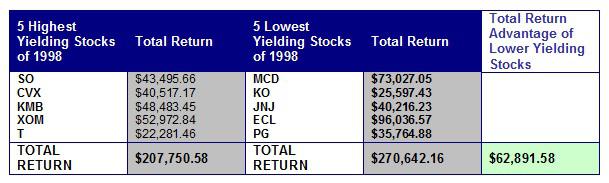
A high yield doesn't mean that you will also get a high total return. If you get big dividends but the stock price falls, your return will turn negative.

The attached chart spells out the cost to the investor of focusing on yield over a long period of investing history. 


Investors who emphasized yield when purchasing stocks from this group of beloved cherry-picked Dividend Growth stocks missed out on earning the equivalent of a year's worth of a nice middle-class salary over the 18 years studied here.


You might see that a portfolio with lower yielding stocks delivered more total return due to a larger stock price appreciation than higher yielding stocks with lower growth possibilities.


Today I would like to introduce a few lower yielding Dividend Achievers with a fantastic future prediction. The attached list ranks midcap plus Dividend Achievers by its future EPS growth forecast. Only stocks with a debt to equity ratio under 1 were observed.


Here are the 20 top results, sorted by growth...


20 Low Yielding Dividend Achievers
That Might Deliver A Better Total Return
Than High-Yield Stocks
(click to enlarge)

20 MLPs To Get Money From Without Filling K-1

For investing purposes, MLPs and LLCs can be a great way to maximize the amount of cash that can be paid to investors, because these organizational structures don't pay income tax, but pass that burden along to those who are invested in it. The same goes for some trust structures.

In other words, because these entities don't pay corporate taxes, the full burden falls on those receiving income from them. This differs from dividend income paid to shareholders by a typical corporation in that regular dividends are taxed as long-term capital gains, while much of the income paid and shown on a Schedule K-1 can be classified as regular income. That means it's taxed at your effective income-tax rate, which is often much higher than the 15% or 20% long-term capital gains rate for corporate dividends.

In summary, a Schedule K-1 issuing entity may be able to pass more income along to you, the investor, but you may end up giving more of it back in taxes than if you'd received regular dividends from a corporation. It really boils down to your tax rate, and how much more income the LLC, MLP, or trust is able to pay.

In order to have less effort with your portfolio allocation and your investment, you could avoid such stocks with K-1 schedules.

Nevertheless, if you like to invest into stocks with a master limited status, you could look at the following list. Each of the stocks are MLP's with status Partnership "C" corporation. Those companies create a classical 1099 Filling and don't send you K-1's.

Here is the list...enjoy it and share it with your social friends...

9 Must-Have Stocks That Should Become Bigger During The Next Recession

When the stock market drops in value, high quality dividend stocks that are less sensitive to the broader economy tend to significantly outperform.

This means that your performance will also suffer but less than the overall market.

A second issue is that large caps with a big footprint in its industry and healthy financial ratios will perform better in stormy times. Smaller and riskier positioned competitors will be thrown out of the market.

That's why most recession will make market leaders often bigger and stronger.

Companies that consistently raise their dividends tend to be very healthy businesses with long-lasting competitive advantages.

Dividend investors like to look for these stocks in the dividend aristocrats list and the dividend kings list, which contain high quality dividend stocks that collectively outperformed during the last recession and have raised their payouts for at least 25 and 50 consecutive years, respectively.

Attached you will find 9 of the currently most attractive stocks which could grow bigger during a market downturn or a recession.

Here are the ideas...

20 Value Income Stocks With Dividend Yields Over 10 Year Treasury Yield

I found a great list of stocks that combine value investing criteria with growth. The list contains a number of attractive looking stocks with current yields above the bond yield. 

It's a classical leveraged view. If you borrow money and put it into investments with a yield over your capital cost, you will make money. Dividends are not stable. 

You need a huge spread yield. However, take a look at the attached list. I believe there are a few good names on it. 

Here is the table....